Why Helderberg Businesses Need a Fast Website
A slow website costs you customers before they ever see what you offer. Here is why speed matters specifically for Somerset West, Strand, and Gordon's Bay businesses, and what LaunchCraft does about it.
Why Helderberg Businesses Need a Fast Website
If you run a business in Somerset West, Strand, or Gordon's Bay, the speed of your website is not a technical detail you can leave for later. It decides whether someone who finds you on Google actually sees what you offer, or gives up and clicks back to the search results. A fast website Helderberg businesses can rely on is one of the few things that affects almost every visitor, on almost every device, every single day.
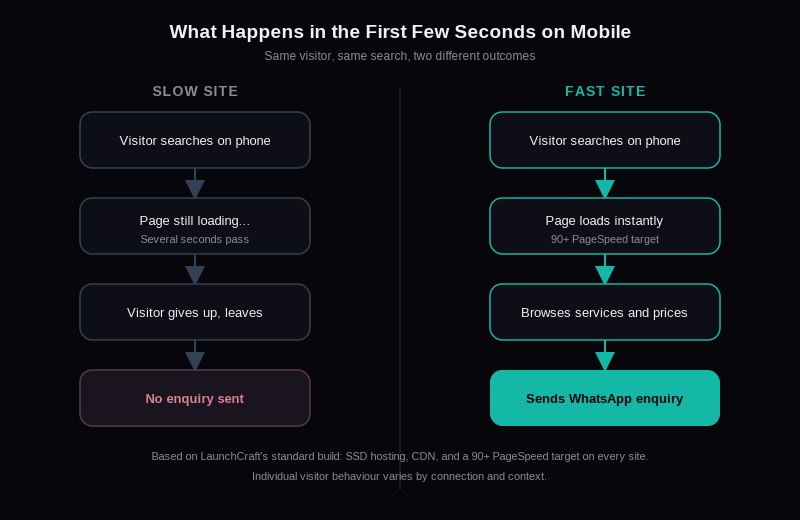
This is not about chasing a perfect score for its own sake. It is about what happens in the first few seconds after someone taps your link.
What "fast" actually means, in plain terms
When people talk about website speed, they usually mean one of two things:
- How long the page takes to appear after someone clicks a link or search result. This is what a visitor actually experiences.
- How the page performs on tools like Google PageSpeed Insights or web.dev's Core Web Vitals report, which score technical details like how quickly the main content becomes visible and how quickly the page responds to a tap or click.
Both matter, and they are related: a site that scores well on those tools is almost always the one that feels instant to a real visitor. You do not need to understand the technical scoring to care about the outcome. You just need to know that a page which takes several seconds to show anything is losing people who would otherwise have found you.
Why this matters more in the Helderberg specifically
The Helderberg is not one uniform market, and that is exactly why speed matters here. As we've written about on our Helderberg coverage page, the customers behind these searches are rarely sitting at a desktop with time to wait:
- A Strand tradesperson's customer is often searching from a phone on a job site or in a bakkie between calls, not browsing at leisure.
- A Gordon's Bay guest house gets booking enquiries from overseas visitors planning six months ahead, frequently on slower mobile connections while travelling.
- A Stellenbosch wine estate gets tourists checking tasting times and opening hours from a phone in the car, often with one hand on the wheel at a stop sign.
- A Somerset West professional services firm gets searched by someone who wants an answer now, not someone browsing for entertainment.
In every one of these cases, the visitor has already decided they might want what you offer. The only question left is whether your website gets out of the way fast enough for them to find out. A slow page does not just feel sluggish, it actively loses that visitor before they ever see your services, your prices, or your contact details.
The real cost of a slow website
A slow website costs you in a few concrete ways:
- Lost visitors before they see anything. If a page takes too long to show its content, some visitors leave before it finishes loading, especially on mobile data rather than Wi-Fi.
- Weaker standing with search engines. Google has said publicly that page experience, including loading speed, is one of the many signals it considers in search rankings. It is not the only thing that matters for local SEO, and it will not rescue a page with no real content, but a slow site works against you rather than for you.
- A worse first impression. For a business that depends on trust, whether that's a guest house, a professional services firm, or a tradesperson, a site that stutters or jumps around while loading reads as unpolished before a visitor has read a single word.
None of this requires a visitor to consciously notice "this site is slow." Most people do not analyse why they left. They just leave, and you never hear about it.
How LaunchCraft builds for speed
This is not something we bolt on afterward. Every website we build runs on hosting with SSD storage and CDN integration, on infrastructure backed by a 99.9% uptime guarantee, and we build toward a 90+ Google PageSpeed score as standard rather than as an upsell. That hosting, together with ongoing speed and uptime monitoring, is R199 a month, starting 30 days after your site goes live, the same as every LaunchCraft site regardless of which package you choose.
Once your site is live, ongoing maintenance keeps it that way: regular security updates, backups, and speed monitoring so a site that launches fast does not quietly slow down a year later as plugins, scripts, and uncompressed images get added without anyone noticing.
Being based in Somerset West ourselves also means faster turnaround on the build itself. Most Helderberg business websites we build go live within 5 to 7 working days of the brief being signed off, so you are not waiting months to fix a slow or outdated site in the first place.
What you can check on your own site right now
You do not need to take anyone's word for how fast your current site is. Two free tools will tell you directly:
- Google PageSpeed Insights scores your actual page and lists specific things slowing it down, from image size to render-blocking scripts.
- web.dev's Core Web Vitals report shows how your site performs against Google's own page experience benchmarks, using real-world data where available.
Run your homepage through either one. If the score is poor, the report itself usually tells you why, whether that's oversized images, too many scripts, or a hosting setup that is not built for it.
The bottom line for Helderberg business owners
A fast website will not single-handedly fill your enquiry list. You still need the right services listed, clear pricing or a clear next step, and local SEO that helps people find you in the first place. But speed is the one thing that affects every visitor before any of that content has a chance to work. Get it right, and the rest of your site gets a fair shot at converting the people who find it.
Frequently asked questions
How fast should a website actually load?
There is no single number that applies to every site, but tools like Google PageSpeed Insights score your site and flag what is slowing it down. At LaunchCraft we build toward a 90+ PageSpeed score as standard, which is a reasonable target for most small business sites.
Does website speed actually affect Google rankings?
Google has said publicly that page experience, including loading speed, is one of many ranking signals. It will not fix a site with no content or no local SEO on its own, but a slow site works against you rather than for you, especially on mobile.
Why does this matter more in the Helderberg than elsewhere?
A lot of Helderberg searches happen on a phone away from a desk: a tradesperson's customer searching from a job site, a tourist booking a Gordon's Bay guest house from overseas, a Stellenbosch visitor checking opening hours on the way through. A slow page loses that visitor before they see anything.
What does LaunchCraft actually do to make a site fast?
Every LaunchCraft site runs on SSD storage with CDN integration, built to a 90+ PageSpeed target, on hosting with a 99.9% uptime guarantee. That hosting and ongoing speed monitoring is R199 a month, starting 30 days after your site goes live.
How do I check if my current site is fast enough?
Run your homepage through Google PageSpeed Insights or web.dev's Core Web Vitals report. Both are free and will show you exactly what is slow and why, without needing to take anyone's word for it.
Where to start
- Run your current site through Google PageSpeed Insights and see what it flags.
- Check how your homepage feels on mobile data, not just office Wi-Fi.
- If you are building a new site, ask any agency or freelancer what speed target they build to, and whether it is included or an extra.
- See our pricing page for what a fast, properly hosted site costs with LaunchCraft, or message us on WhatsApp and we will take a look at your current site.
Ready to implement these strategies?
Put these strategies to work for your business. Our Cape Town team handles the implementation.